
Open Innovation 2025:
Six Trends for Corporate Innovation Leaders
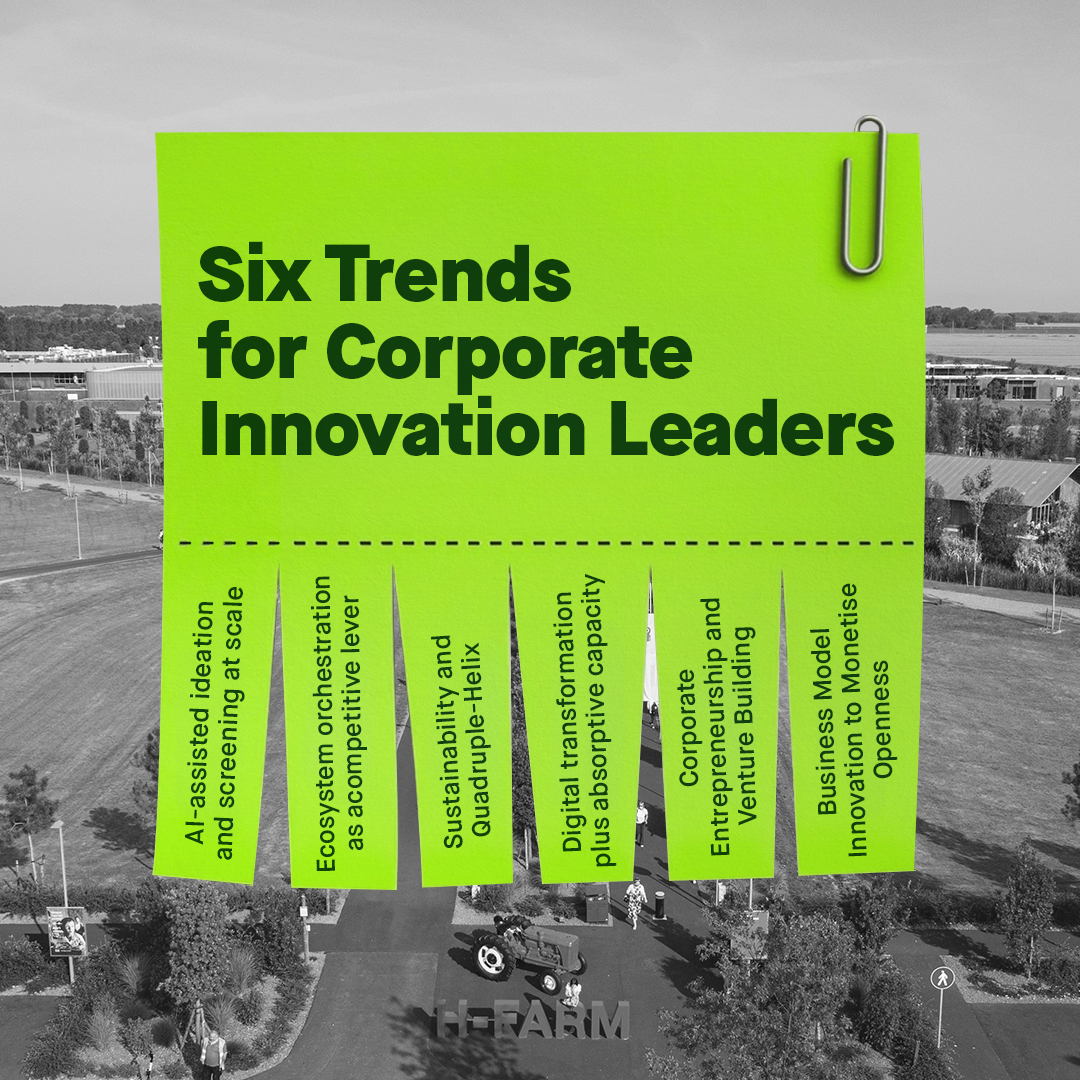
In the two decades since it was coined, “open innovation” has grown into a mainstream business strategy embraced by companies and policymakers alike. Yet many organizations still struggle to fully realize it, often internal barriers (corporate silos, culture) block knowledge-sharing more than a lack of external ideas (Chesbrough, 2023). Now, as technological and market shifts accelerate at unprecedented speed, tapping external innovation sources has become even more critical.
This article is based on a recent research initiative led by Timothy O’Connell. It distills the latest thinking and foundational research on open innovation. The work draws on years of practical experience supporting founders, deep ties to the entrepreneurial ecosystem, and direct insights from faculty, startup operators, and innovation leaders across Europe.
I risultati indicano sei tendenze trasversali che influenzeranno il modo in cui le aziende, in particolare le grandi società, struttureranno e amplieranno le loro strategie di innovazione aperta nel prossimo decennio.
Executive Summary
Basierend auf den aktuellsten Erkenntnissen und grundlegenden Forschungen zum Thema offene Innovation werden sechs übergreifende Trends die Art und Weise prägen, wie Unternehmen offene Innovation in den nächsten zehn Jahren praktizieren werden:
1. AI-Assisted Ideation and Screening at Scale
Artificial intelligence is becoming a powerful enabler of open innovation that can “enhance, enable, or replace” traditional innovation practices by generating, filtering, and recombining ideas at a scale humans alone cannot (Stanisławski & SzymaniecMlicka, 2024). For example, AI-driven systems can rapidly scan vast datasets (patents, publications, startup databases) to spot emerging technologies and partners.
AI tools now produce thousands of idea variants in seconds, prompting companies to rethink their innovation process from problem identification to execution (Lane, 2025). The practical upside is faster idea pipelines and broader search scopes. However, executives must also institute robust governance around AI usage in innovation to manage issues of bias, data privacy, and intellectual property.
La ricerca sottolinea l'importanza di combinare la velocità dell'intelligenza artificiale con la creatività e la supervisione umana: le aziende vincenti formeranno i propri dipendenti a lavorare a fianco dell'intelligenza artificiale e ridisegneranno i propri flussi di lavoro innovativi di conseguenza. In breve, l'intelligenza artificiale è un moltiplicatore di forza per l'innovazione aperta: se utilizzata in modo responsabile, consente agli innovatori aziendali di gettare una rete molto più ampia per idee e partner, concentrando al contempo il talento umano sulla valutazione e l'implementazione.
2. Ecosystem Orchestration as a Competitive Lever
As open innovation matures, leading companies are moving from one-to-one collaborations toward orchestrating whole ecosystems of partners. Henry Chesbrough observes that the next decade will see a shift to multi-directional knowledge flows across organizations, enabled by digital platforms and networked ecosystems (Chesbrough, 2023).
The role of the “ecosystem orchestrator”—whether a large company, public entity, or neutral platform—is to coordinate a network of contributors in creating shared value (Heaton et al., 2025). Real-world examples demonstrate the power of an ecosystem strategy. Industrial giant Siemens, for instance, has positioned itself as an ecosystem orchestrator through its open digital platform Xcelerator, inviting a network of partners to co-develop solutions. Siemens shares data and co-innovation spaces, leveraging AI-driven insights to anticipate needs and drive collaborative product development. On the other hand, a Boston Consulting Group analysis found that over 85% of business ecosystems fail, with inadequate governance cited as the number one reason; more than half of ecosystem failures are due to core governance issues such as poorly defined participant roles and decision-making authority, often manifesting as conflicts over how to share the value created among partners (Daniel et al. 2023).
La lezione per gli innovatori aziendali è chiara: trattare i partner semplicemente come fornitori o lasciare la collaborazione multipartitica al caso è una ricetta per l'attrito. Invece, le aziende dovrebbero investire in una governance robusta dell'ecosistema e in un'orchestrazione "adattiva", adeguando il modello man mano che la rete evolve.
3. Sustainability and Quadruple Helix Collaboration
Open innovation is increasingly intertwined with sustainability goals that require collaboration far beyond company boundaries. In this context, the quadruple-helix model (Yun et al., 2020) has become a defining framework for how innovation ecosystems evolve. Building on the classic “triple helix” of industry–academia–government collaboration, the quadruple helix adds a fourth dimension—civil society—recognizing that citizens, NGOs, and communities play a vital role in shaping, testing, and scaling sustainable solutions.
In practical terms, this model positions sustainability not as a side activity but as a shared operating system where multiple actors co-create solutions to societal challenges, from climate change to public health, by sharing knowledge, data, and infrastructure (Wilson et al., 2024).
A clear illustration came during the COVID-19 pandemic: unprecedented open collaboration among governments, corporations, and universities accelerated the development of vaccines and therapeutics. These efforts showed that openness isn't just altruistic; it can be a strategic response to systemic crises, yielding faster solutions when diverse players pool knowledge (Chesbrough, 2020). For corporations, the takeaway is that sustainability-focused innovation works best when they actively engage all four helices as equal partners. Whether it's co-creating circular economy solutions or setting industry standards for ESG, companies should leverage open innovation platforms to combine their resources with the expertise of others. By doing so, they not only accelerate problem-solving but also build public trust and alignment, increasingly important as customers and regulators look for genuine, large-scale impact rather than isolated “optics.”
4. Digital Transformation and Absorptive Capacity as Twin Drivers
The research underscores that digital transformation and a company’s absorptive capacity (its ability to recognize and integrate external knowledge) act as twin engines powering open innovation performance. Investing in advanced digital technologies can significantly enhance a firm’s capability to sense external ideas and collaborate at speed (Kim et al., 2024). For instance, digital transformation boosts open innovation outcomes primarily by building dynamic digital capabilities which in turn improves the ability to source and implement outside ideas (Qiu & Chang, 2025). Crucially, the benefits are greatest in volatile, high-tech environments where agility is at a premium. Firms that heavily adopt Industry 4.0 technologies (like IoT, automation) and cultivate strong absorptive capacity see far greater returns from open innovation projects.
In other words, digital investments need to go hand-in-hand with organizational learning processes, training talent, knowledge management, R&D partnerships, to effectively absorb and apply new knowledge (D’Angelo et al., 2024). Digital infrastructure (from secure cloud workspaces to blockchain IP tracking) also helps democratize access to innovation by enabling smaller or geographically distant partners to participate on equal footing (Xie et al., 2023). The lesson for innovation leaders is two-fold: double down on digital capabilities that help your team discover, share, and develop ideas faster, and invest in your people’s capacity to absorb and apply new external knowledge.
5. Corporate Entrepreneurship and Venture Building Inside the Firm
Another prominent trend is the rise of internal venture building and corporate entrepreneurship as a way to turn open innovation into tangible new businesses. Rather than relying on traditional R&D alone, large companies are increasingly adopting startup-like approaches, forming internal venture teams, incubators, or spin-off ventures, to capitalize on external ideas and emerging technologies. Henry Chesbrough and others note that while big firms can't behave exactly like lean startups, they can import entrepreneurial methods (rapid experimentation, MVPs, hypothesis testing) and give internal teams more autonomy to explore novel opportunities uncovered via open innovation (Chesbrough, 2020).
Companies are also embracing models such as accelerators, venture client programs, and corporate venture capital to feed their internal innovation funnel. For innovation executives, the message is to treat internal entrepreneurship as a disciplined capability. That means providing budget, C-level support, and appropriate governance to venture teams. In sum, open innovation should not remain a buzzword or a siloed scouting activity; it needs to feed into a robust corporate entrepreneurship pipeline.
Le aziende che sviluppano questa capacità saranno in grado di incubare le "prossime grandi novità" internamente (o in partnership), assicurando che le idee esterne si traducano in concrete opportunità di crescita e non solo in presentazioni PowerPoint.
6. Innovazione del modello di business per monetizzare l'apertura
Finally, companies are learning that to fully profit from open innovation, they often must reinvent their business models. Research encourages firms to experiment with models like platforms, subscriptions, or data monetization that align with open knowledge flows (Lu & Tucci, 2024). In practice, we see this in some of the most successful companies today.
A classic example is Rolls-Royce’s “Power by the Hour” model for jet engines: instead of selling engines outright, Rolls-Royce leases them and charges airlines based on hours of operation, essentially turning a product into a service. This kind of servitization is a form of open innovation in itself, as it “externalizes” what used to be internal assets and relies on ongoing knowledge exchange and collaboration between the company and its customer. For corporate managers, the key takeaway is to always consider the business model implications of open innovation initiatives. Ask: if we source this technology externally or co-create it with partners, do we need a new way to capture value? Perhaps the innovation should be delivered “as a service,” or maybe intellectual property could be openly licensed to foster an ecosystem (as Tesla did by opening up some of its patents).
Open innovation often expands the market, but you need a strategy to secure your share of that larger market. Companies that innovate not only their products but also their business models can better monetize collaborative innovation. The next decade will reward organizations that are as creative in designing business models as they are in designing new products and technologies.
Conclusion & Key Takeaways
In an era defined by exponential technological progress and AI-driven acceleration, innovation leaders must look beyond their internal R&D to harness the full potential of external ideas, partners, and ecosystems.
The research and practice reviewed here point to six imperatives shaping the next generation of open innovation:
Le aziende che prospereranno in questo nuovo panorama saranno quelle che considerano l'apertura non come una tendenza, ma come un principio operativo fondamentale, integrando la collaborazione, la sperimentazione e il pensiero ecosistemico in ogni livello della loro strategia di innovazione.