Supply Chain and AI:
The Big Discrepancy. 99% Talk About It, 19% Do It.
The Perspective of the Center of Excellence in Digital Operational Excellence
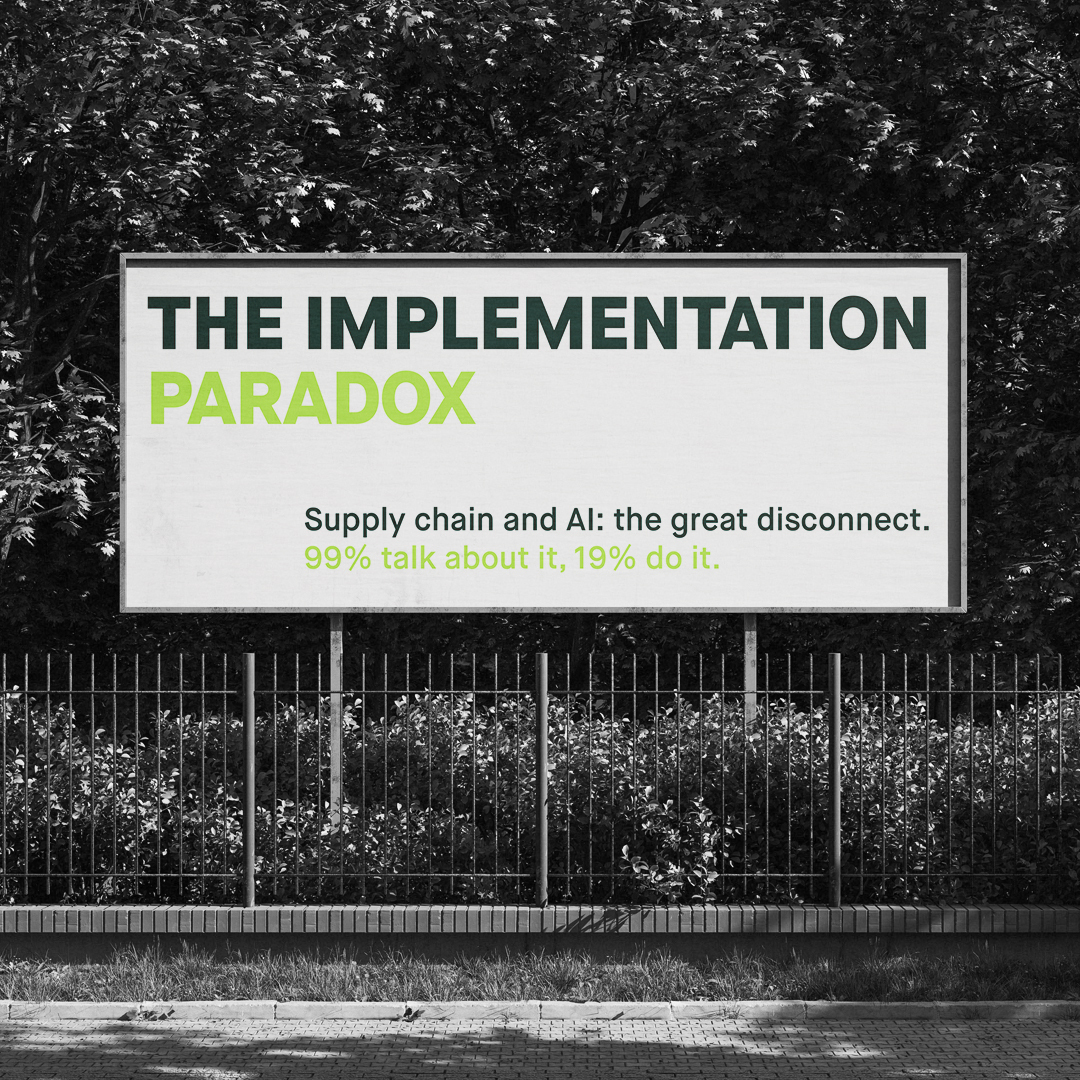
The supply chain has seen the greatest disconnect between narrative and industrial reality in the past decade. West Monroe reports that 99% of industry leaders claim productivity gains from AI. McKinsey corrects this: only 19% have fully implemented it in their operational processes—a figure that has remained unchanged since 2024. Gartner adds: just 23% of companies have a true AI strategy for the supply chain. This is precisely the AI “Death Valley”—full of exciting pilots, enthusiastic slides, and stagnant results.
The technology, in and of itself, works. The surrounding infrastructure, not so much. For more than half of companies, the problem lies with the data: disconnected between ERP, planning, and logistics, scattered across databases that don’t communicate with one another. They’re asking an AI—which operates on a foundation that wouldn’t even support a well-built Excel spreadsheet—to handle forecasting and replenishment. Then there are the people: between 45 and 49% of employees resist, but almost never out of fear of the future. More often, they believe that their deterministic process—the one that keeps the factory running—works better than a probabilistic system that makes guesses. And they’re right—until someone redesigns the operational model around them. Add in the context—100% tariffs on Chinese imports, the U.S. ruling against the IEEPA, and data center cancellations set to quadruple by 2025—and postponing major investments seems like a prudent move. It’s what economists call the “wait-and-see” option: investing little today to reserve the right to scale up tomorrow, when the path forward is clear.
The problem is that the train has already left the station. Amazon has projected $2 billion in savings by 2025 with 21,000 autonomous agents: the Delivery Address Agent alone has reduced first-delivery failures by 74.4%. Siemens, in partnership with PepsiCo and NVIDIA, is building Digital Twins that detect 90% of issues before a screwdriver is even picked up. Blue Yonder, o9, Kinaxis, SAP IBP, and Oracle have completely rewritten their architectures to accommodate autonomous agents. The common thread is hard to admit: they didn’t add AI to an existing operational model; they rebuilt it from scratch, with end-to-end integrated data and intelligence at the core of the architecture, not in a separate application layer.
This is where diagnosis turns into action. Without ERP, planning, and logistics speaking the same language, forecasting remains a pipe dream. The coexistence of AI’s probabilistic nature and the factory’s deterministic nature must be planned in advance, not endured after the fact. People must be reassigned to new roles, not replaced or left to suspect that AI is just another problem on their desk. The option to wait is no longer available. What matters is the courage to redesign operational models with AI at their core, not merely alongside them.