
Why Everyone Uses AI,
but Very Few Know How to Guide It

AI is no longer just a toy
Ever since the first version of ChatGPT was released online in 2022, I’ve heard people say time and again: “This isn’t for me; it’s useless,” or “I tried using it, but it doesn’t work; it doesn’t do what I ask it to.” In some cases, that was certainly true, but today we’re no longer dealing with just a fun little toy. Ongoing research and investment in generative artificial intelligence have yielded tangible results that cannot be ignored.
In recent months, more and more people have been using it at work and in their daily lives—for example, to create a personalized birthday invitation for their children, to write a difficult email to their building manager, or to figure out how to file their taxes. But let’s take the most common and general use case: web search. When we do any search on Google, the first thing that appears on the screen is the AI overview—a summary that answers our query and is generated on the spot for us.

Meta has also chosen to integrate Meta AI into WhatsApp, while Microsoft has renamed the Microsoft 365 hub app to Microsoft 365 Copilot, and the trend is clear: major tech companies are integrating generative AI into all the software interfaces we’re used to using because the goal is to streamline processes and boost productivity. This process of integrating AI, however, does not automatically lead to the development of the skills needed to use it successfully.
Adoption – Everyone uses it, but few understand it
When we talk about adoption, we mean one simple thing: the tool has become part of our routine and is being used.
In 1962, sociologist Everett Rogers defined the innovation adoption curve as the process through which a new technology spreads throughout a society, moving from a small group of pioneers—known as innovators and early adopters—to the majority of the population. According to this model, generative AI is currently in the early majority phase: it has crossed the critical threshold beyond which a technology ceases to be perceived as experimental and becomes a normal, accessible, and accepted tool.
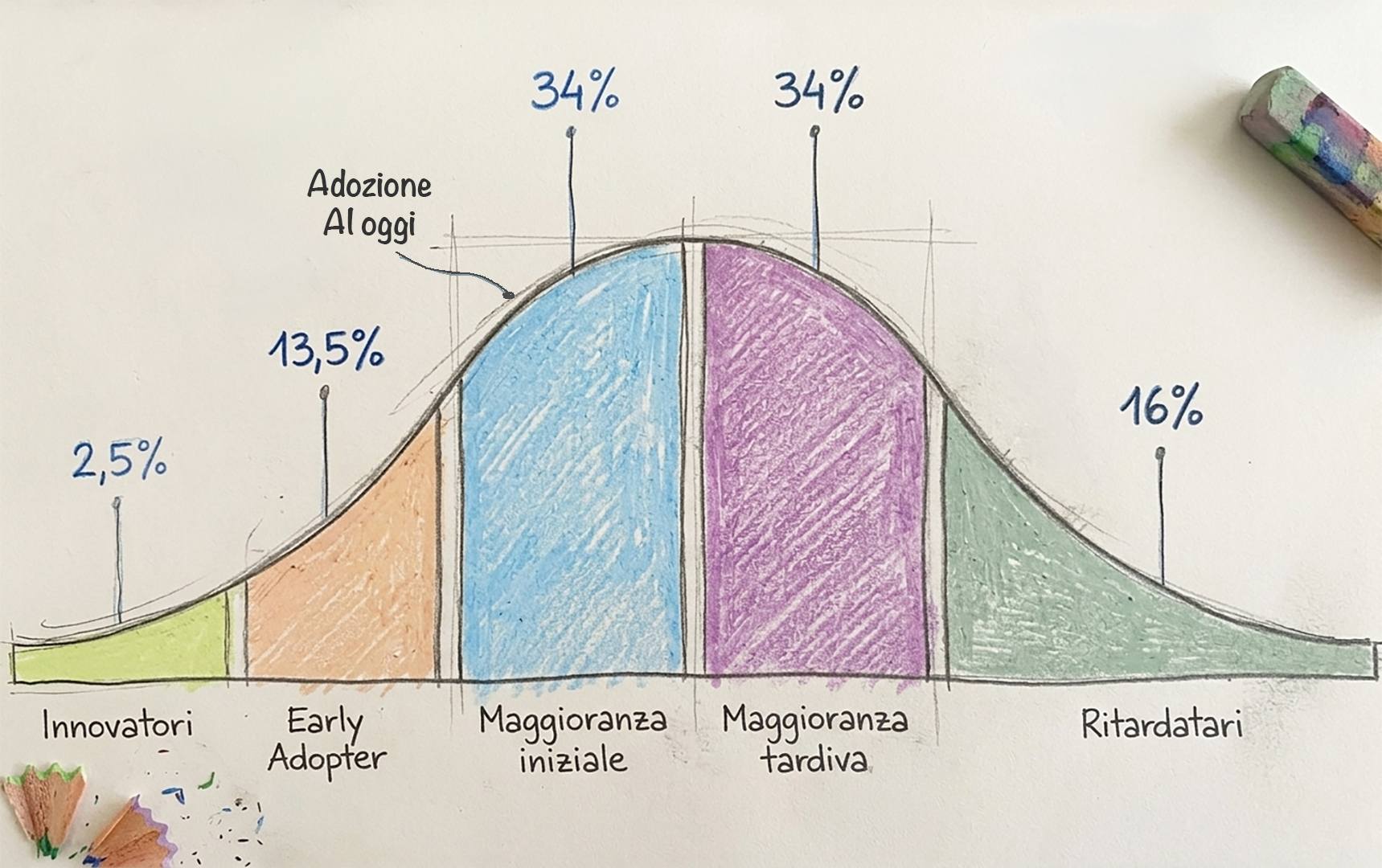
A few months ago, there was discussion about a potential artificial intelligence bubble, fueling tension and uncertainty, but the release of the latest large language models, such as Claude Opus 4.7, GPT 5.5, and DeepSeek 4, has brought the debate back to a concrete level: whereas there were previously doubts about the replicability of use cases, today we can confirm their feasibility and demonstrate the versatility of AI in both academic and professional contexts.
As a result, the barrier to entry for adopting generative AI has been further lowered, since anyone with an internet-connected device can use a chatbot, and use cases are spreading very quickly thanks to social media. Despite this, the first problem to be solved concerns the effectiveness of the results obtained because
Power is nothing without control.
This slogan from the famous Pirelli ad masterfully captures the need for knowledge to unleash potential, and that is exactly what is happening with AI.
Slop – The Hidden Cost of Adoption Without Expertise
The term "SLOP" has entered common parlance in the context of AI and is used to refer to low-quality content, often generated automatically. In some cases, SLOP is created with the intention of going viral, but in the vast majority of cases, it remains a digital product with no value for the data economy.
Generative AI systems have a single function: to generate content. They respond to user requests with a focus on plausibility rather than quality, because the generated content must appear realistic and as coherent as that created by a human. Chatbots lack internal quality controls because the output is generated based on the probability that words are related to one another, according to statistical analyses of vast amounts of text.
When we use a chatbot, the only tool we have to control it is the prompt. Linguistic skill and common sense help us craft effective prompts, but we need to be aware that we’re interacting with a machine that has learned to simulate conversation through mathematics. There is no human understanding or reasoning, no empathy, and if we don’t refine our requests, we get empty answers and quickly find ourselves immersed in AI slop.
To achieve results that better meet your expectations and overcome the frustration caused by ineffectiveness and wasted time, it is essential to learn how to write prompts; there is no other way.
AI projects often fail because there’s no consistent approach to using them, not because of the technology itself. The real irony? With a simple prompt, the chatbot itself can help us establish that approach.
The problem today isn't AI, but our ability to guide it.
Tech Savvy – Understanding to Avoid Being Taken Advantage Of
If the prompt is the rudder of our boat, understanding its structure is essential to steering it. This doesn’t mean becoming engineers—just as you don’t need to know how to build a boat to steer it—but it does require a solid understanding of the AI ecosystem.
Questions such as:
These issues are common when you first start using generative AI, and there’s no clear-cut answer, because these tools need contextual data to work at their best. You might choose a tool because it’s generally considered the best for solving certain problems, but it may turn out that, for you and your specific context, it isn’t effective, while a less well-known tool might be a better fit for your needs.
AI is a complex ecosystem, and there are no single “right” answers. Gaining a deep enough understanding of it allows us to develop the technological awareness needed to guide and manage the effective adoption of generative tools.
The Human’s Role – Guiding the Purpose
Technological development is advancing at breakneck speed, and we are all pioneers in this revolution in generative AI. The latest wave of development has given us the ability to install and use AI agents on our devices, which act autonomously to achieve the goals we set for them.
It sounds like science fiction, yet it’s a reality, and if you browse YouTube, you’ll find tutorials on everything: from installation to cost control, from improving an agent’s performance to building entire teams.
The illusion that “anything is possible without effort” is always on the horizon of our journey, but there is a solution: listen, study, try, and engage with others.
The AI Fundamentals Deep Immersion course at H-FARM Business School aims to unlock your untapped AI potential by providing you with all the necessary tools to enhance your technological understanding.
Machines have no purpose in and of themselves; it is always humans who define that purpose.
Only you can decide whether and how to use AI—always remember that.