AI Venture Bootcamp

Where your next big thing begins

AI Venture Bootcamp

Where your next big thing begins

Starting in Winter 2026 | Duration: 3 months | 5 modules | 5 artifacts

from Winter 2026

Do you want to spend a year writing a business plan that expires in three months, or do you want to find out in five weekends if your idea is viable?

Five weekends in Roncade. The H-FARM Startup Center approach: AI in every session, a mentor at the table.

Three concrete takeaways:

Proof that the market exists, with reliable sources.

A working prototype, built by you, tested on real people.

A six-minute pitch that has already been presented to founders and investors.

SUPER EARLY BIRD
2.470 €
EARLY BIRD
2.990 €
FULL PRICE
3.880 €

For companies, the price does not include VAT.
The SUPER EARLY BIRD rate applies to the first 8 registrants; the EARLY BIRD rate applies to registrants 9 through 16.

Admission process

1

CANDIDATES

Click on the "APPLY" button and complete the application form by answering a few questions

2

COLLOQUY

Book and take an online selection interview with an Orientation and Admission expert

3

OUTCOME

Once you have passed the evaluation of the scientific committee, you can embark on your journey in H-FARM

Admission process

1.

APPLY: Click on "apply," fill out the online form, and submit your application.

2.

SUPPORT THE INTERVIEW: Participate in an online interview with the Orientation & Admission team

3.

FIND OUT THE RESULT: Receive the selection result and start your journey at H-FARM.

The program

Each weekend produces a component of your startup, and the next one builds on that. Five weekends, five deliverables: business model canvas, market and metrics, prototype, launch plan, pitch. Put together, they form your final presentation. No exercises based on fictional companies.

1. OPENING: IDEA, TEAM, PROBLEM

Winter 2026 – In Person

Are you sure that anyone actually has the problem you want to solve?

On Friday, you walk onto campus, learn how the method works, and see AI applied in real time to a real-world venture problem. On Saturday, you form a team, choose a challenge or pitch your own idea, define the problem and the customer facing it, and put your idea through the Idea LaunchPad’s screening process: desirability, feasibility, and economic sustainability. Those who arrive without an idea will find one here; those who already have one will compare it with at least one alternative, to have something to measure it against.

With AI: scan a sector for potential issues, generate concept variations, and prepare questions for your first interviews before you even leave the classroom.

What you should check: that the problem actually exists. AI can suggest a hundred pain points; what matters is the conversation with someone who actually has one.

Present: the completed LaunchPad Canvas with your chosen idea, and the team’s initial presentation in front of everyone.

Friday night: Storming Pizza:See how others pitch to an audience and who’s building what before you open your canvas.

2. MARKET AND BUSINESS MODEL: IS THERE ROOM FOR GROWTH, AND CAN IT BE PROFITABLE?

Winter 2026 – In Person

An idea that everyone likes but doesn't turn a profit is an expensive hobby.

Estimate the market size from the top and bottom (TAM, SAM, SOM), documenting every source and every assumption. Choose your beachhead—the first segment to target—based on five criteria: accessible, in need, willing to pay, influential, and easy to understand. Map out three types of competition, including customers who take no action. Then build the business model: Lean Canvas, revenue archetype, customer acquisition cost, and lifetime value.

With AI: desk research, initial market estimates, and a list of competitors in minutes instead of days; a unit economics spreadsheet built and stress-tested against comparable businesses.

What you should check: every number. Market figures without a named source are discarded. A clean model built on a made-up conversion rate remains made up.

Include: market analysis with sources and a well-reasoned beachhead; competitive map with positioning and strategic wedge; Lean Canvas and unit economics (CAC, LTV, and the relationship between the two).

3. PRODUCT: FROM CONCEPT TO WORKING PROTOTYPE

Winter 2026 – In Person

An idea without a product remains merely an intention.

It’s the weekend when the rules really change. You design user flows based on what a client has told you, build wireframes using AI tools, and test them informally in a classroom setting. Then you narrow the scope down to the single statement that most needs to be tested, and build the prototype using AI and no-code tools. You don’t learn to code: you learn to describe what you want with enough precision to make it happen. Before the evening is over, you put it in the hands of at least one person outside the team.

With AI: user flows, wireframes, and a working prototype in a single day, based on a written specification.

What you should check: that the prototype tests the hypothesis for which you built it. A beautiful screen that answers the wrong question is the most common mistake of the day.

Submit: the design package (flowcharts, wireframes, specifications) and a working prototype with the assumption being tested labeled next to it.

4. LAUNCH: HOW TO ATTRACT YOUR FIRST CUSTOMERS AND MAKE YOUR FIRST MONEY

Winter 2026 – In Person

A finished product without users or capital won't get anywhere.

On Fridays, you work on the go-to-market strategy: brand positioning, one or two selected and defended channels, a pricing model tied to the value the customer receives, a customer acquisition cost modeled on the beachhead strategy, and a launch sequence with specific dates. On Saturday, you’ll move on to capital and the narrative: how much you need and to reach which milestones, who the right investors are for each stage and investment thesis, what’s in a data room, and how to read a term sheet. Then comes the Presentation Matrix, the sixty-second pitch that’s been rehearsed over and over, and the first complete deck assembled from the materials you already have—not written from scratch.

With AI: naming options, positioning drafts, channel benchmarks, investor research by stage and investment thesis, deck structure, and a mock partner who asks you the obvious questions an investor would ask.

What you should check: that the brand says something a competitor couldn’t say, that channel costs are based on real benchmarks, and that every name on the investor shortlist is consistent with their portfolio. Juries can immediately tell when a pitch deck is templated.

Come prepared with: a go-to-market plan including positioning, pricing, channels, and a timeline; a funding strategy covering the funding target, use of funds, and a shortlist of investors; and a first complete deck and a 60-second pitch.

Late Night with Investors
On Friday evenings, after class, two informal hours with an investor: how a startup is viewed from the other side of the table, what makes them say yes, and what makes them close the email after just a couple of lines. No slides, just real questions.

5. CLOSING: PITCH DAY

Winter 2026 – In Person

On Friday, you wrap up the presentation with the artifacts from the previous four weekends. One mentor for every two teams scrutinizes it, checking it against the artifacts—not against personal taste. Then comes the gym pitch: each team gives a timed pitch in front of the room, with feedback from peers and mentors. It wraps up with the final deck, the speaking order, and who answers which question.

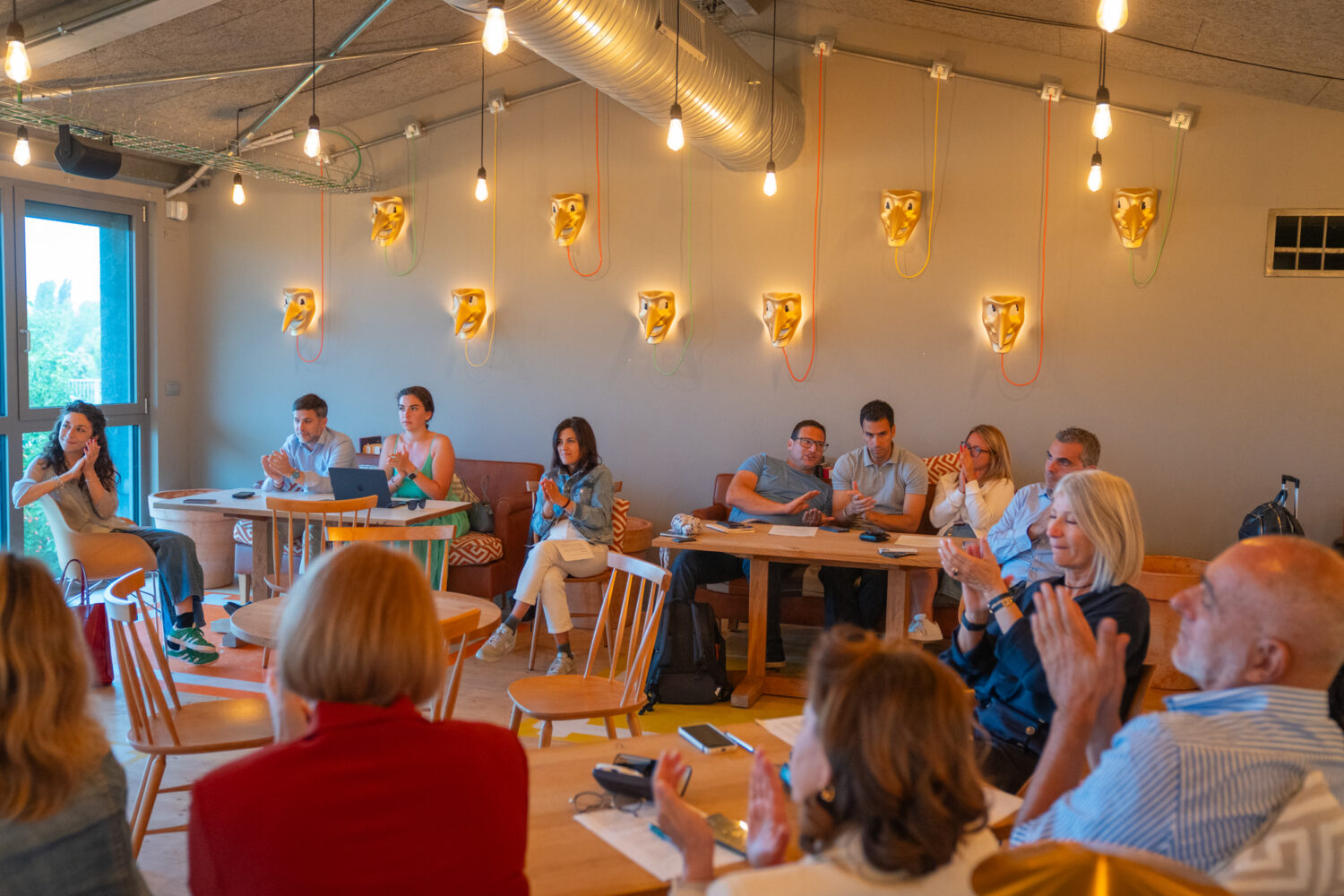
Saturday is Pitch Day. Each team has six minutes to present to a panel of faculty, founders, and investors from the H-FARM ecosystem, followed by questions. The panel asks each team three things: what you’ve learned, what you’ve changed, and what’s next. And a fourth: how AI has shaped the project and how you’ve validated its results. AI isn’t used on stage.

This isn't an exam. You'll come in with a project you've refined weekend after weekend and a pitch you've already tested in front of real people.

You'll walk away with: your final pitch and a page of written feedback from the jury on your project.

After the Bootcamp, you'll know

BY THE END, YOU'LL HAVE COMPLETED YOUR FIRST YEAR AS A FOUNDER. IN FIVE WEEKENDS.

If your idea holds up—before you invest any money— you’ve spoken with the people facing the problem, assessed the market size using data from reliable sources, and figured out where the project will generate profit. If it doesn’t hold up, you’ll find out here and change course.

Building with AI as a founder: research, interviews, unit economics, prototypes, and pitch decks created with AI by your side—and the rule that matters more than the tools: whatever you produce is just a draft until there’s a source, a client, or a test to back it up.

Speaking to decision-makers: a six-minute pitch, a presentation deck where every slide refers to something you’ve actually done, and answers to the questions a panel always asks: what did you learn, what did you change, and what are you doing now.

Who we are looking for

NOT THOSE WHO WANT TO STUDY ENTREPRENEURSHIP. THOSE WHO WANT TO TEST AN IDEA.

You’ve read the books, watched the videos, and attended the free webinars. Your idea is still stuck where it was. You’re not lacking content—what you’re missing is someone to ask, “And what’s your source?” a group that’s building something just like you, and five deadlines that force you to produce something.

Anyone who's had an idea in mind for months and doesn't know where to start.

Those who already have a prototype or an early version but are proceeding based on intuition and want to know if they're heading in the right direction.

Anyone who has a stable job and an idea that won't leave them alone, and wants to see if it's viable before taking the plunge. Even if you don't have an idea yet: the first weekend is for coming up with one.

The method

ARE YOU WORRIED ABOUT WASTING TIME ON THEORETICAL CLASSES OR ABOUT NOT BEING ABLE TO BALANCE THEM WITH YOUR JOB?

The H-FARM Startup Method is the approach the Startup Center has used to mentor over 250 startups: four phases, sixteen steps, with a deliverable at each step that the team must be able to present and defend. It’s what prevents five intense weekends from turning into a series of interesting talks. 

Five weekends, all in-person at the Roncade Campus. The method works when the team works at the same table, with a mentor who stops by and asks you for your source code, and you can test a prototype best by putting it in the hands of the person sitting across from you.

Weekends run from Friday afternoon (2:30 p.m. – 6:30 p.m.) through all day Saturday (9:00 a.m. – 6:00 p.m.). Between weekends, you’ll work on your project—conducting interviews, running tests, and verifying sources—for about 4–6 hours a week. 

Pitch Day

Winter 2026 – in person

The Pitch Day is not an exam. Six minutes per team in front of a panel of faculty, founders, and investors from the H-FARM ecosystem, followed by the questions a panel always asks: what have you learned, what have you changed, and what’s next. And a fourth question: where has AI shaped the project, and how did you verify its results?

YouYou arrive with a project that’s been refined weekend after weekend, a pitch you’ve already tested in front of a live audience on Friday, and you leave with feedback from the juryon your project. It’s not a promise of investment—it’s the first time your project has been evaluated by professionals in the field.

People First, AI Always

AI isn't a separate subject. It's woven into every phase of your project: research, interviews, unit economics, prototyping, and the pitch deck.
The method determines what counts as evidence. AI determines how quickly you can obtain that evidence.
WHERE AI HELPS YOU MOVE FASTER

Scan a market in an afternoon. Write up interview questions before leaving the classroom. Put together a unit economics sheet and a working prototype in a single day. Work that, until recently, took a month.

WHERE YOU'RE VALID

Even a marketable product created in ten minutes still needs a source. Even a prototype built before lunch still needs a real user to test it. This is a bootcamp rule, established on the first day: whatever the AI produces is just a draft until there’s a source, a customer, or a test to back it up.

0
WEEKEND
0
TRAINING HOURS
0
ARTIFACTS
0
PITCH DAY

Learning Experience

Our program does not consist of traditional lectures.
At H-FARM Business School, learning is continuous and integrated; we design comprehensive educational experiences to help you achieve your goals and foster exchange, networking, and personal growth.

LATE NIGHT
: WHO'S INVESTING?

 On Friday of Weekend 4, after class, two informal hours with an investor: how a startup looks from the other side of the table, what makes an investor say yes, and what makes them close the email after just a couple of lines. No slides, just real questions.

STORMING PIZZA
, AND IMPACT STORIES

On the first Friday, before we open the canvas, we’ll take you to Storming Pizza: see how to pitch in front of an audience and what others are building. On campus weekends, founders who have failed, pivoted, raised capital, and sold their companies answer the questions you won’t find in textbooks.

YOUR "
" PROJECT IS THE PROGRAM

No exercises based on made-up companies. Each weekend ends with a deliverable from your startup: a business model canvas, market analysis, prototype, or pitch deck. Put together, these form your final pitch. If you come in without an idea, you’ll work on a challenge as part of a team formed on the first day.

Career Boost

It consists of a series of activities focusedon professional development that will help you define your career goals and identify your strengths, with the aim of improving your communication, teamwork, and leadership skills, thereby accelerating your professional growth.

Soft skills

We believe in the value of soft skills, and in our programs we offer a structured opportunity to discuss and analyze the most in-demand soft skills today and how best to develop them by building on your own strengths.

Personal Branding

A workshop focused on using the canvas to define each student’s unique selling proposition (USP), build motivational drivers, and focus on soft skills.


Finance your training

“Per Merito”loan

with Intesa Sanpaolo

“Futuriamo”loan

with BNL

Paymentin installments

with H-Farm Business School

Paymentin installments

with SeQura

MASTER'S FACULTY

AI Venture Bootcamp

AI Venture Bootcamp Applicants

Frequently Asked Questions

Do you need a college degree or a technical background?

No. You don't need a degree, and you don't need to know how to code. Over the weekend, you'll build your product using AI and no-code tools, and the mentors are there to help. We evaluate your motivation and the coherence of what you want to build.

Do I have to be on campus every weekend?

Yes. All five weekends will be in-person at the Roncade Campus: the method works best when the team works at the same table, with a mentor who stops by and asks you for the source code, and you can test a prototype more effectively by putting it in the hands of the person sitting across from you.


Can I participate even if I don't have a startup idea yet?

Yes. That's exactly what the first weekend is for: you choose a challenge, join a team, and leave with a real-world problem to work on.

Can I apply with my co-founder? And if I'm working on someone else's idea, who owns the project?

Yes, and that’s the best way to approach it: on the first weekend, instead of forming a team, we’ll put your idea through a stress test against at least one alternative. If, on the other hand, you come in without an idea and join a team, the project belongs to whoever brought it: simply working together doesn’t create partners or equity stakes.

Is AI taught as a separate subject? Do I have to develop an AI product?

No to both. AI is the tool you use in every session to work on your project—whether it’s research, market analysis, prototyping, or creating a pitch deck—and each session tells you what you still need to verify yourself. You can show up to Pitch Day with an AI-powered product or with any other kind of startup.

What happens if I find out that my idea doesn't hold up?

It’s one of the possible outcomes of the program, and it’s not the worst one. The worst is finding out two years later. If, by the second weekend, it becomes clear that there’s no market or the numbers don’t add up, you’ll work with your mentors to decide whether to change direction, idea, or team.

How do I apply, and when will I receive a response?

Schedule an online consultation with the Orientation & Admission team, tell us what you have in mind, and receive a response within five business days.

When are the classes held?

In-person sessions are held on Friday afternoons (2:30–6:30 p.m.) and Saturdays (9:00 a.m.–6:00 p.m.).

What kind of degree is awarded upon completion of the program?

Upon completion of the course, you will receive a certificate of completion and a digital Open Badge that you can share on LinkedIn as official proof of the skills you have acquired.